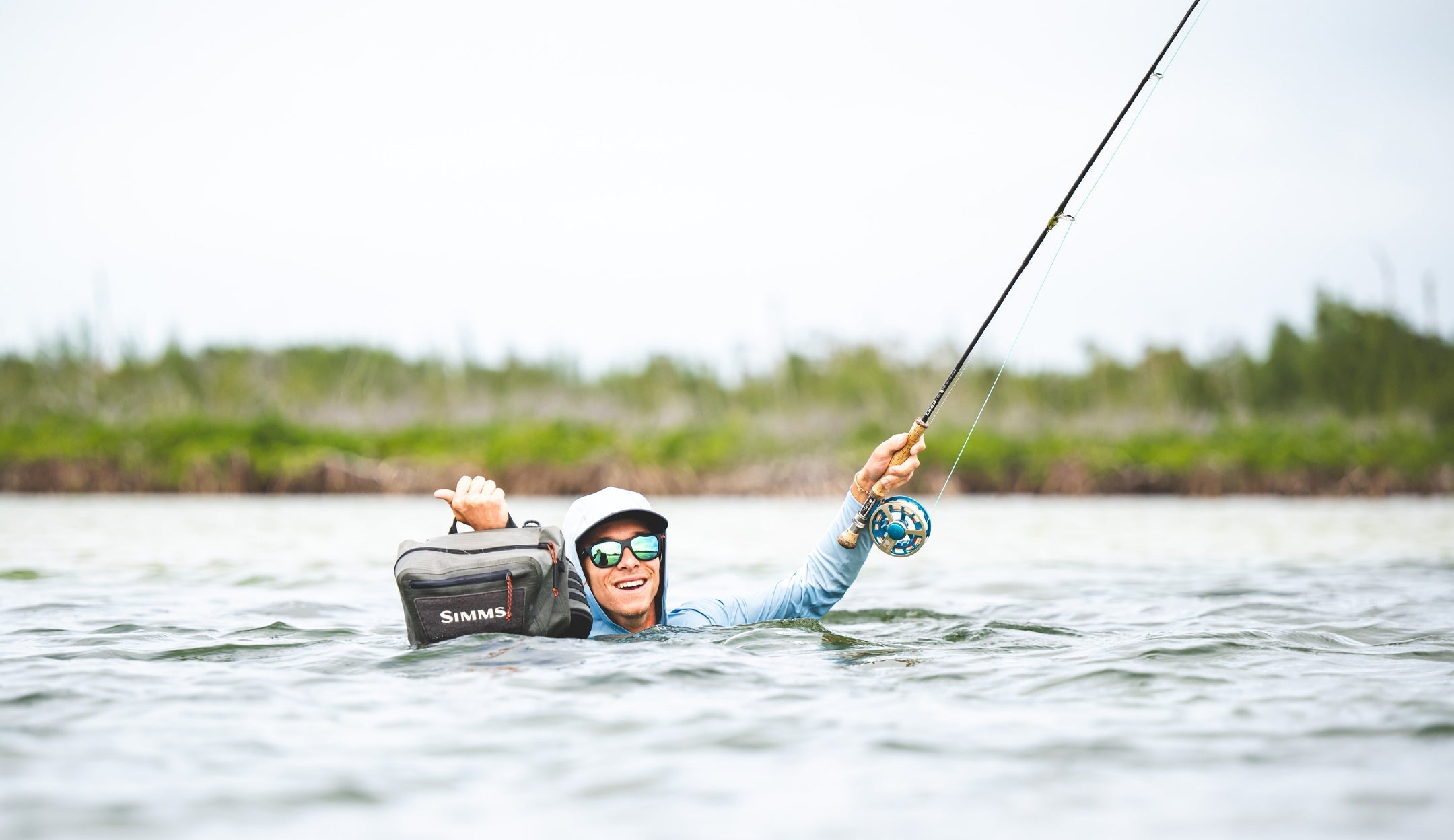
Some guides put you on fish. Others have the ability to make your time on the water equally as unforgettable as your best catch of the trip. Travis Sands is a guide who consistently delivers both. Born and bred in the Bahamas, Travis has a keen eye for spotting bonefish — but what sets him apart is the way he does it. Always smiling, always laughing, always making the experience unique and memorable, Travis brings an energy to the skiff that’s contagious. Whether you're a first-timer or a seasoned angler, a day with Travis isn’t just about chasing bonefish — it’s about the stories, the moments, and the type of vibes that make you wish the tide would never turn. In the Q&A below, Travis provides a little insight on what it's like to grow up in the Bahamas, what it takes to become a successful guide, and some of the tactics he implements to ensure success on the flats.
Simms: So obviously, we know you are from the Bahamas. What island were you born?
Sands: I was born on South Andros but now I live in the Berry Islands, currently on Great Harbor Key.
Simms: Wow, we’re definitely jealous of that. Tell us a little more about what it was like growing up on South Andros?
Sands: In a word, slower. [Laughs]
Simms: I assume you mean slower in a good way, yeah?
Sands: Oh man, 100%. Growing up on Andros was amazing. You know, quiet, laid back, tons of amazing fishing, and diving. You know it’s the largest island in the Bahamas, but also one of the least developed.
Simms: Do most of the folks that grow up on Andros get into fishing, diving, or other things that revolve around the ocean?
Sands: Some do, but probably not nearly as many people as you might think. More or less, if you grow up on a place like Andros, your options are to get to Nassau where there’s a lot more diversity in terms of career paths, work odd government jobs, or get into fishing, or diving. But really, being a bonefish guide in the Bahamas is definitely one of the top jobs.
Simms: When you say, “not nearly as many as you might think”, why do you suppose that is?
Sands: Well, I think it’s because not every kid growing up in the Bahamas has access to boats which is a huge thing when it comes to learning our waters.
Simms: So how did you get into it?
Sands: My dad was a commercial fisherman and also a bonefish guide.
Simms: Was it something you got into just because of your dad’s profession? When we see photos or videos of you with your clients, you seem to genuinely love every second you are on the water. Was it always that way for you?
Sands: Oh yeah, man. I always loved being on the water, the flats, and the creeks. That was literally my playground as a kid. But that’s what I mean, because I grew up with a fisherman for a father, I learned a ton of skills that I didn’t even realize I was learning at the time. I was just always around or on the water and I just absorbed so much from that and that really helped me a ton when I decided I wanted to become a guide.
Simms: In what sense?
Sands: I think a lot of people think that to be a guide, you have to know when and where fish are going to be. That’s true, but man, it’s so much more than that. At least for me. When I decided I wanted to become a guide, I realized that there are just so many skills you have to learn that I never even thought of or realized.
Simms: So with that said, what do you think is the biggest thing you learned as a result of growing up on and around that water that really helped you become the guide you are today?
Sands: No doubt, the biggest skill I learned was really understanding how to read the water. And by that, I mean learning how to run and maneuver the creeks and flats and all. To me, to really understand how it all works, you have to be out there, see it for yourself, and do it for yourself. It’s just really hard to teach somebody to run a boat, read the water, know what’s safe, and where it’s safe to be on what tide, etc.
Simms: And you’re saying that because of your father’s profession, you were exposed to these types of things from an early age?
Sands: Exactly. In my case, I think because of my upbringing, I had a leg up because I really learned through association by just running around with my dad. I just think that because all of these things are things I grew up doing, I inherently had a much better understanding of it all.
Simms: What’s your best guess as to when you were first exposed to bonefishing?
Sands: Man, when I was a wee little baby.
Simms: When did you start breaking away from your dad and exploring on your own?
Sands: Oh man, when I was very young, probably too young [laughs]. My cousin’s dad had a boat. Man, we would steal that thing and head to the west side and run through all those creeks. My cousin and I definitely slept in the back of the boat a few times because we got so lost in those creeks, or got stuck on a low tide. We definitely spent some cold nights in those creeks boy. But that’s what I was talking about, I really learned a lot from all those experiences — because I didn’t want it to happen again [laughs]. But you know how it is when you’re a kid, it’s dangerous, it’s an adventure, your parents told you not to — all of that made my cousin and I want to do it more. Those were some really great times for sure.
Simms: Is it safe to say that a lot of kids that grow up in the Bahamas have never been to the flats or really seen what bonefishing is and what it’s all about?
Sands: Yeah man, I think that’s very accurate. Just because you are born and raised in the Bahamas doesn’t mean you are aware of the flats, the fishery, the opportunities. I’d say that’s 100% accurate. I can’t tell you how many of my friends I grew up with have never been to the West side, been in the creeks, seen the flats, or even understood what bonefishing is, and they all grew up on the same island as me.
Simms: When you do get one of your friends on the boat and expose them to what exactly is out there, what’s their reaction?
Sands: Oh man, every time, their mind is blown. Very quickly, they realize there’s another world right in their backyard. It’s beautiful, the water is unbelievable, the wildlife — they typically fall in love right away.
Simms: So once you did start venturing out on your own with or without your parent’s consent, what were the most important things you learned? Or was there a specific unlock that gave you the confidence to pursue becoming a bonefish guide?
Sands: I think the biggest hurdle to becoming a guide in the Bahamas like I said earlier is understanding the tides. I know that sounds pretty straightforward but in the Bahamas and I’d imagine other places around the world, understanding the tides isn’t that simple or cut and dry.
Simms: What do you mean by that?
Sands: Well, once you figure out how the tides work, that’s cool and all, but really that’s only part of it. You have to then start factoring in how the wind direction and wind speed affect the water levels. Every wind direction has an effect on the tide, especially if the wind is over 15 mph. You can get wind-driven tides. So by that I mean, you have to learn what areas you can go on certain tides and certain winds. In other words, you have to be able to figure out which areas are safe to go depending on the wind as it relates to that tide. And really, the only way to figure that all out and how they are related is to go through all the cycles year after year. It’s actually really technical. But man, once you master the tides and the winds, finding fish is actually relatively straightforward. Once I mastered that, man, it started to get really fun. It was definitely an unlock.
Simms: So in short, it’s not only mastering the tide, it’s the interplay of the tide and the wind that dictate where you can and can’t be?
Sands: Exactly.
Simms: And as far as finding the fish, once you figure out where you can and can’t be, finding the fish is almost the easy part?
Sands: Yes, because remember, fish follow the tide as well.
Simms: So it sounds like you are essentially targeting a certain water depth based on wind and tide. Is that correct? If so, what exactly are you looking for in terms of depth?
Sands: Pretty much, yes. I’m looking for depth, the right depth that is. I’m never fishing in 3 or 4 feet over water. Bonefish don’t really like to hang out in that depth either because they are less protected from sharks barracuda, dolphins, and osprey. They tend to prefer to stay in ankle to calf-deep water. The reason is, that they know ospreys won’t risk diving in at them in that shallow water because they might break their neck. Also, sharks, barracuda, and dolphins can’t get in that shallow water, or at least it’s harder for them to get in that depth of water. So it keeps the predators away to a certain degree.
Simms: Is there an ideal tide for you?
Sands: Not really, as long as water is moving. To me it doesn’t really matter if it’s outgoing or incoming, I just want movement. It’s like traffic hour. When the water is moving, bonefish use it to get to where they need to be. If the tide is dropping down, they’re coming out of those mangroves heading to the flat. If the tide is coming in, they are trying to get back to those mangroves. I’m just trying to position myself in those areas where I know I’m going to intersect their highway. Or, put myself in the areas that I know they are going to use to get from point A to point B.
Simms: It sounds like the overarching strategy is: Based on the wind and the tide, what you are looking for are areas that are going to have moving water where it’s ankle to calf deep water.
Sands: Pretty much. If I’m in that depth and the water is moving, I’m happy.
Simms: So now that we’ve talked about how you go about finding fish, what’s your philosophy on the presentation and the feed?
Sands: I always tell my clients, you don’t have to have a super long, clean cast to catch these fish, but you do have to have quiet feet. You know bonefish don’t have any teeth or spines or anything like that to defend themselves. They are kind of like the gazelles of the flats, their only defense is to be super alert, and super fast. So when it comes to presentation, I obviously want to be as stealthy as possible, whether that’s with the cast or wading, I want to be as quiet as possible. It sounds so basic because it is, but I just can’t stress the importance of stealth.
Simms: Any thoughts on where you want to fly to land in relation to the fish?
Sands: You know, in deeper water, I feel like you can get the fly a little closer because the deeper water kind of cushions the fly a little bit, but in tailing water, I like to keep the fly at least two feet away from the fish.
Simms: And do you wait to strip based on the fish’s body language?
Sands: No. I like to go straight into long and slow strips.
Simms: Interesting. Any reason why you go straight into long and slow strips?
Sands: One, I like to go straight into stripping because I want to get any and all slack out so the client can feel the bite, but also, I like to keep the fly moving.
Simms: Seems to be that most flats guides adhere to long and slow. Do you have any theories on why?
Sands: What I’ve noticed is smaller bonefish don’t really seem to mind that kind of pop, pop, jigging action. Smaller bonefish seem to just run right over to check it out. The bigger fish though, that kind of action really seems to disturb them. They just like longer, slower strips. They’re smarter though [laughs]. A small fish is like a little kid. They see something bouncing around, they want to go see what it is because they are curious. They’re going to go look at it and maybe eat it without thinking of the consequences. I also think that smaller fish don’t use their smell, or at least they don’t pay much attention to what they are smelling. Those bigger fish, definitely use their smell. To me, the bigger/older bonefish get, their thinking patterns change. The older/bigger fish is wise. It seems that pop, pop action and thinks, wait — this doesn’t look right, and they move away from the fly.
Simms: Spotting fish is obviously such a big part of what makes Bahamian guides so great. Do you have any tips on how anglers can become more proficient at seeing fish?
Sands: It just takes a lot of time staring at the water. Really the more you stare at the water and see fish, the better your ability to spot fish will be. But for me, it also really depends on the conditions in terms of what I’m looking for. On cloudy days, I’m looking for wakes, pushes, tails, and things like that. In fact, on cloudy days, I might even look in shallower water than normal, just to increase my odds of seeing fish. When it’s full sun, I’m looking for the same things, but also I’m looking for moving shadows on the bottom, reflections of tails from the sun, and things like that.
Simms: When you have clients who are struggling to see fish, what’s your move?
Sands: You know, I have them point their rod at a time. That way at least they are zeroed in on a specific area. From there, I’ll tell them how many feet away and tell them, to move their rod a little to the left, or a little to the right until they are pointing right at it. Hopefully, at that point, they see the fish because I really want them to gain visual before they cast.
Simms: Can you share how you might go about targeting larger fish in the Bahamas?
Sands: Again, I’d say the biggest thing is depth. Definitely depth. While I do like to hang in that ankle-to-calf deep water, if I’m targeting a big bonefish, I like to look for those areas that have access to deeper water. So like drop-offs, edges, and areas like that are where I tend to target bigger bonefish.
Simms: Why is that would you say?
Sands: Those bigger fish just typically don’t like to be way up on the flat like the smaller ones do. They really like those edges and drop-offs. They’re bigger so it’s harder for them to be efficient in water that’s too shallow for them. I also think those bigger fish like to have access to deeper water because they are always going to want to have an escape route to get away from predators like sharks and barracuda. I also think their diet changes the bigger they get. They don’t want to be competing for food with smaller fish or schools of fish.
Simms: How does their diet change?
Sands: I think they start eating little mud minnows and things like that when they start approaching double-digit sizes. But also, I think they do start targeting slightly larger crabs and shrimp and those edges and drop-offs are where you start to find those larger crabs and shrimp.
Simms: What is the most common mistake you see your clients make?
Sands: Sunscreen [laughs]. I mean, like I say, I really like to keep the fly moving at all times for a couple of reasons, but the biggest reason is, I don’t want the fish to ever get a chance to smell the fly. People don’t realize when they have sunscreen on their hands and they are playing with the fly between shots, that sunscreen is just soaking into that craft fur, man. So yeah, that’s a big one for me.
Simms: What’s your typical setup for Bahama bonefish?
Sands: I like an 8-weight with a floating line and a reel with a reliable drag. Nothing fancy.
Simms: How about your leader setup?
Sands: I like about 11 feet down to 16 lb. I just think 11 feet is manageable to cast but gives a little extra stealth. I also like 16 lb. because anglers can typically get the fish in quicker, it gives a little insurance against mangroves, especially mangroves with small barnacles on them, but also, 16 is nice to have if you run into one of the giant bonefish we have in the Bahamas.
Simms: So what is the largest bonefish you’ve encountered in the Bahamas?
Sands: Man, I’m telling you I can say 13 lbs easy. I remember I saw these three fish one time and I would have sworn they were sharks. They were huge.
Simms: So after all the bonefish you’ve seen, you’ve caught, you’ve guided clients to — when you see a fish of that caliber do you still get nervous?
Sands: Oh, hell yeah! [laughs] Man, seeing a fish like that is a privilege to me. I’m not even going to lie to you. If I saw a 30+ lb. permit and a 13 lb. bonefish, I’m going to abandon that permit every time [laughs]. Don’t get me wrong, I understand a permit of any size is a very special thing but a 13+ lb. bonefish man — that’s a unicorn.
Simms: Have you fished all around the Bahamas? Are there any islands that you have yet to explore?
Sands: Oh yeah, I’ve fished most of the Bahamas. But yes, there are a few islands that I haven’t hit just yet. I don’t want to say which ones, but I do have plans to hit them all very soon.